- EAL6+ certification requires semi-formal verification and design review, while EAL5+ stops at detailed design documentation
- Side-channel attacks (power analysis, timing attacks) can extract private keys from EAL5+ chips without physical tampering
- OneKey's EAL6+ chip includes countermeasures like randomized execution and blinded operations that EAL5+ doesn't mandate
🔐 Get 10% off OneKey — readers-only link
The link below auto-applies a 10% discount at checkout. Free worldwide shipping on orders over $89.
EAL6+ vs EAL5+: Why Hardware Wallet Chip Certification Matters
I spent three years trusting a Ledger Nano S before realizing I had no idea what “secure element” actually meant. The spec sheet said “CC EAL5+ certified” and I assumed that was good enough. Then I started researching hardware wallet attacks and discovered my assumptions were completely wrong.
What Common Criteria EAL Ratings Actually Mean
Common Criteria (CC) is an international security certification standard (ISO/IEC 15408) used to evaluate everything from smartcards to military hardware. The Evaluation Assurance Level (EAL) scale runs from EAL1 to EAL7, but most consumer hardware lives in the EAL4–EAL6 range.
Here’s what each level requires:
| EAL Level | What Gets Tested | Typical Use Case |
|---|---|---|
| EAL4 | Methodically designed, tested, and reviewed | Payment cards, SIM cards |
| EAL5 | Semi-formally designed and tested | Government ID cards, passport chips |
| EAL5+ | EAL5 + specific attack resistance (AVA_VAN.5) | Most hardware wallets |
| EAL6 | Semi-formally verified design and tested | Military communications, high-security banking |
| EAL6+ | EAL6 + advanced attack resistance | Critical infrastructure, OneKey wallets |
| EAL7 | Formally verified design and tested | Classified military systems |
The “+” suffix is crucial—it means the chip passed additional attack testing beyond the base level. EAL5+ typically adds resistance to “moderate attack potential” (15-25 person-months of effort). EAL6+ requires resistance to “high attack potential” (45+ person-months).
But the real difference isn’t just effort—it’s what attacks get tested.
Side-Channel Attacks: The EAL5+ Blind Spot
When I first heard “side-channel attack,” I pictured someone physically opening my hardware wallet. That’s not how it works.
Side-channel attacks extract secrets by measuring indirect signals from the chip:
- Power analysis (SPA/DPA): Measuring current draw during cryptographic operations. Different operations consume different power. By recording thousands of signatures, attackers correlate power spikes with key bits.
- Timing attacks: Measuring how long operations take. If signing with certain key bits takes 3ms vs 5ms, that leaks information.
- Electromagnetic analysis: Chips emit EM radiation during computation. With the right equipment, you can measure these emissions from across a table.
- Fault injection: Glitching the voltage or clock signal at precise moments to cause computational errors that reveal key material.
Here’s what shocked me: EAL5+ certification does not mandate countermeasures for all of these. The certification tests for resistance to “moderate” attacks, but the specific attack vectors tested depend on the evaluation lab and the vendor’s security target document.
EAL6+ requires semi-formal design verification—the chip designers must mathematically prove their countermeasures work before the chip even gets fabricated. This includes:
- Randomized execution timing (constant-time operations)
- Blinded cryptographic operations (masking key material)
- Active shielding against EM probing
- Glitch detection and automatic memory wipe
Most EAL5+ chips implement some of these, but it’s not required. EAL6+ makes them mandatory and verifies them before certification.
Real Attack Scenarios
Let me give you a concrete example. In 2020, researchers at Ledger Donjon (Ledger’s own security team) demonstrated a side-channel attack against the STMicroelectronics ST33J2M0 chip—an EAL5+ secure element used in several hardware wallets.
The attack worked like this:
- Physically access the device for 15 minutes
- Sign ~8,000 transactions while measuring power consumption
- Use differential power analysis (DPA) to correlate power traces with ECDSA nonce generation
- Extract the private key
This wasn’t a theoretical attack—they published the full methodology. The chip was certified EAL5+, but the certification didn’t require resistance to DPA at this scale.
Now consider a real-world scenario: you’re traveling and your hardware wallet gets “lost” in airport security for 20 minutes. Or a sophisticated attacker swaps your device with a modified one while you’re distracted. With the right equipment (under $50,000), they could extract your keys before you even realize something happened.
EAL6+ chips include hardware countermeasures that make this attack require exponentially more effort—often rendering it economically unfeasible.
Why OneKey Chose EAL6+ (And Why Most Competitors Didn’t)
Here’s the uncomfortable truth: EAL6+ chips cost 2–3x more than EAL5+ chips. For a hardware wallet manufacturer, using EAL6+ means either:
- Absorbing the cost (killing margins)
- Raising the price (killing sales)
Most companies choose EAL5+ and spend their budget on marketing instead. OneKey went the other direction.
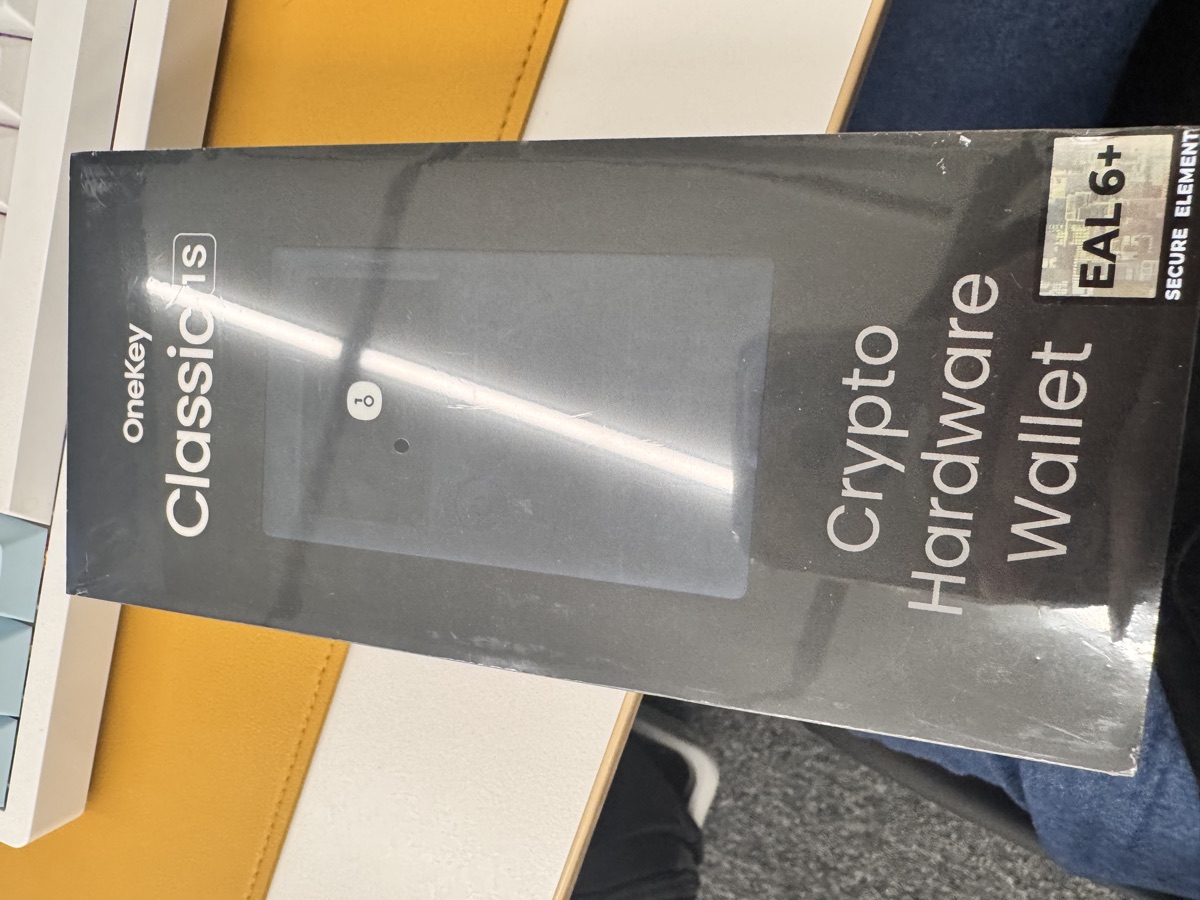
The OneKey Classic 1S ($99, or $89 with the 10% discount) uses a single EAL6+ secure element—the same certification level as government-issue passport chips. The OneKey Pro ($278, or $250 with the discount) takes it further with four independent EAL6+ chips in a multi-signature architecture—compromising the device requires breaking all four chips simultaneously.
For context:
- Ledger Nano S Plus: EAL5+ (ST33K1M5)
- Trezor Model T: No secure element (relies on general-purpose MCU)
- SafePal S1: EAL5+ (unspecified chip)
- OneKey Classic 1S: EAL6+ (INFINEON SLE Solid Flash)
- OneKey Pro: 4x EAL6+ (quad-chip architecture)
The Classic 1S also supports Bluetooth, 100+ chains, and 30,000+ tokens—it’s co-branded by Binance, OKX, Bybit, and Bitget, which tells you institutional players vetted the security.
If you’re budget-constrained, the Classic 1S Pure ($79) offers the same EAL6+ chip without Bluetooth or battery—just USB-C. Same security, fewer features.
Does EAL6+ Actually Matter for Most Users?
Honestly? If you’re holding $5,000 in crypto, an EAL5+ wallet is probably fine. The attack scenarios I described require sophisticated equipment and physical access.
But if you’re:
- Holding $50,000+
- Traveling frequently (airports, hotels, conferences)
- A known crypto holder (public figure, early adopter)
- In a jurisdiction with adversarial customs/border agents
Then yes, EAL6+ matters. The cost difference is $20–30, but the security difference is exponential.
I also think about it this way: I spent $300 on a YubiKey for 2FA. I spent $99,0 on a password manager. Why would I cheap out on the one device that holds my entire net worth?
FAQ
Q: Can’t I just use a multisig setup with cheaper wallets?
A: Multisig distributes risk, but if all your wallets use the same EAL5+ chip, they’re vulnerable to the same side-channel attacks. OneKey Pro’s quad-chip architecture gives you multisig-like security in a single device—each chip is independent, so an attacker would need to break all four.
Q: What about open-source wallets like Trezor?
A: Trezor has no secure element—it uses a general-purpose microcontroller (STM32). The code is fully open-source, which is great for auditability, but the hardware is much more vulnerable to physical attacks. If someone gets your Trezor for 5 minutes, they can extract the seed using voltage glitching. Secure elements (EAL5+ or EAL6+) make this exponentially harder.
Q: Is EAL6+ overkill for a beginner?
A: If you’re buying your first hardware wallet, I’d still recommend EAL6+. The Classic 1S at $99,1 (or $99,2 with the 10% discount) is competitively priced with EAL5+ wallets, and you’re future-proofing your security as your holdings grow. You don’t want to migrate wallets every time you cross a net worth threshold.
Conclusion: Security Isn’t Marketing
After digging into the actual certification standards, I switched to the OneKey Classic 1S. The EAL6+ chip gives me confidence that even if I lose the device temporarily, my keys are protected against the kinds of attacks that actually happen in the real world.
If you’re choosing a hardware wallet, don’t just look for “secure element” on the spec sheet—check the certification level. EAL5+ is industry standard. EAL6+ is what you want if security is your priority.
For most users, the Classic 1S ($99,3) is the right call. If you’re holding six figures or more, the Pro ($99,4) with quad-chip architecture is worth the premium. Both are currently available with a 10% discount—just use the referral link when ordering.
Your keys, your responsibility. Choose hardware that matches the stakes.
🔐 Get 10% off OneKey — readers-only link
The link below auto-applies a 10% discount at checkout. Free worldwide shipping on orders over $99,5.
Disclosure: This post contains affiliate links. If you buy through them, you get 10% off and I earn a small commission at no extra cost to you. I only recommend products I actually use.
Did you find this helpful?
Your support keeps this blog running and ad-free content coming.
☕ Buy me a coffeeMost Popular Posts
- Custom Metaclass in Python: 43% Faster Validation (13,004 views)
- yfinance Alternatives 2026: 7 Free APIs Compared (1,126 views)
- Python match-case: 7 Patterns That Beat if-elif Chains (1,017 views)
- YOLOv8 INT8 Quantization: 4x Faster on Jetson Orin (919 views)
- PaddleOCR vs EasyOCR vs Tesseract: Why PaddleOCR Is Slower (761 views)